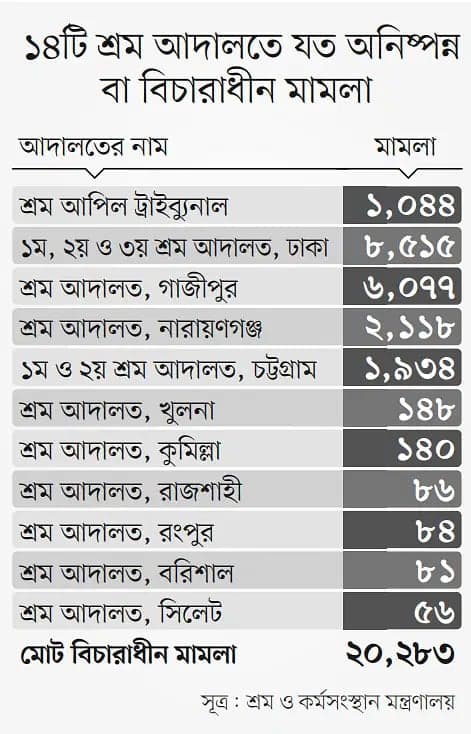
Workers' interests are not being fully protected through the labor courts, with a significant backlog of 20,000 cases awaiting resolution. One of the main reasons for this delay is the lengthy proceedings. In some courts, there are thousands of cases, with some even exceeding 6,000. Judges in these courts are struggling to resolve the cases. However, in four of the 14 related courts, there are no more than 100 cases, and in two other courts, the number of cases is under 200. In the remaining eight courts, the case count exceeds 1,000. Labor courts were established as the final resort for workers to claim their rightful dues. The government set up 14 labor courts across the country, including the Labor Appeal Tribunal. Currently, more than 20,000 cases are still under trial or awaiting resolution in these courts, as confirmed by sources from the Ministry of Labor and Employment. Labor Secretary A.H.M. Safiquzzaman himself acknowledges that the existing labor courts are unable to fully protect workers' rights. As a result, steps are being taken to restructure the labor courts. He mentioned that the new initiative will be implemented with the consent of the Ministry of Law and the High Court Division. When asked what this new initiative might look like, the Labor Secretary explained that the labor court in Cumilla could assist with cases from Narayanganj. Additionally, the judges in the labor courts in Khulna and Barisal might work two days a week in their respective courts, while assisting in courts in Dhaka or Gazipur for the rest of the week. Currently, the Labor Appeal Tribunal has 1,044 cases. There are three labor courts in Dhaka, with the first court handling 4,365 cases. In total, the three courts have 8,515 cases. Gazipur's labor court has the highest number of cases, with 6,077, while the labor court in Sylhet has the least, with only 56 cases. It is reported that in some labor courts, no work is done after 1 p.m. Workers, who must leave their jobs or take leave to attend court, often face delays due to late hearing dates. Because of the prolonged proceedings, workers lose interest in continuing their cases. Justice S.M. Faruk, former chairman of the Labor Appeal Tribunal, identified seven reasons for the unresolved cases in a paper he submitted to the Ministry of Labor and Employment. These reasons include the complexity of labor laws, the lack of an appeal option against interim orders of labor courts, the transfer of labor court judges, the failure of employers and workers' representatives to attend court on time, the incompetence of supporting staff, the absence of centralized authority in the Labor Appeal Tribunal, and the shortage of space in both the labor courts and the Labor Appeal Tribunal. Recently, three workers—Mahbubur Rahman, Rana Sheikh, and Ariful Islam—received a verdict from the labor court in Gazipur against the management of Keya Cosmetics. However, the verdict has not been enforced because several other cases against the same company are still pending. One of the plaintiffs in such a case, Kamrul Islam, shared his experience with *Prothom Alo*, explaining that he had worked as an operator at Keya Cosmetics for 10 years before retiring, but the company had dismissed him without providing any compensation. Keya Cosmetics' lawyer Nasreen Akhtar told *Prothom Alo* that she would comment after reviewing the court order and consulting with the company.

Business
88 words · 29 secShwapno Stands by Women: Allowing Women to Use Their Outlets for Safety If They Face Harassment or Danger
Shwapno has introduced an initiative to support women’s safety. If a woman faces harassment or danger, she can seek refuge at any Shwapno outlet. This move provides a safe space for women in distress, demonstrating Shwa…
Read more→