An extraordinary artwork in the historic city of Naples, Italy, is bringing the suffering of Palestinian mothers and children in Gaza as former photojournalist Eduardo Castaldo has unveiled an installation titled ‘Holy Mothers of Gaza’, on November 11, 2026, at the Pappacoda Chapel. He presented viewers with a striking encounter between Christian religious imagery and the documented reality of life in Gaza, attracting students, teachers, local residents and visitors, turning the historic religious setting into a place for reflection on Gaza, motherhood, human suffering and peace.
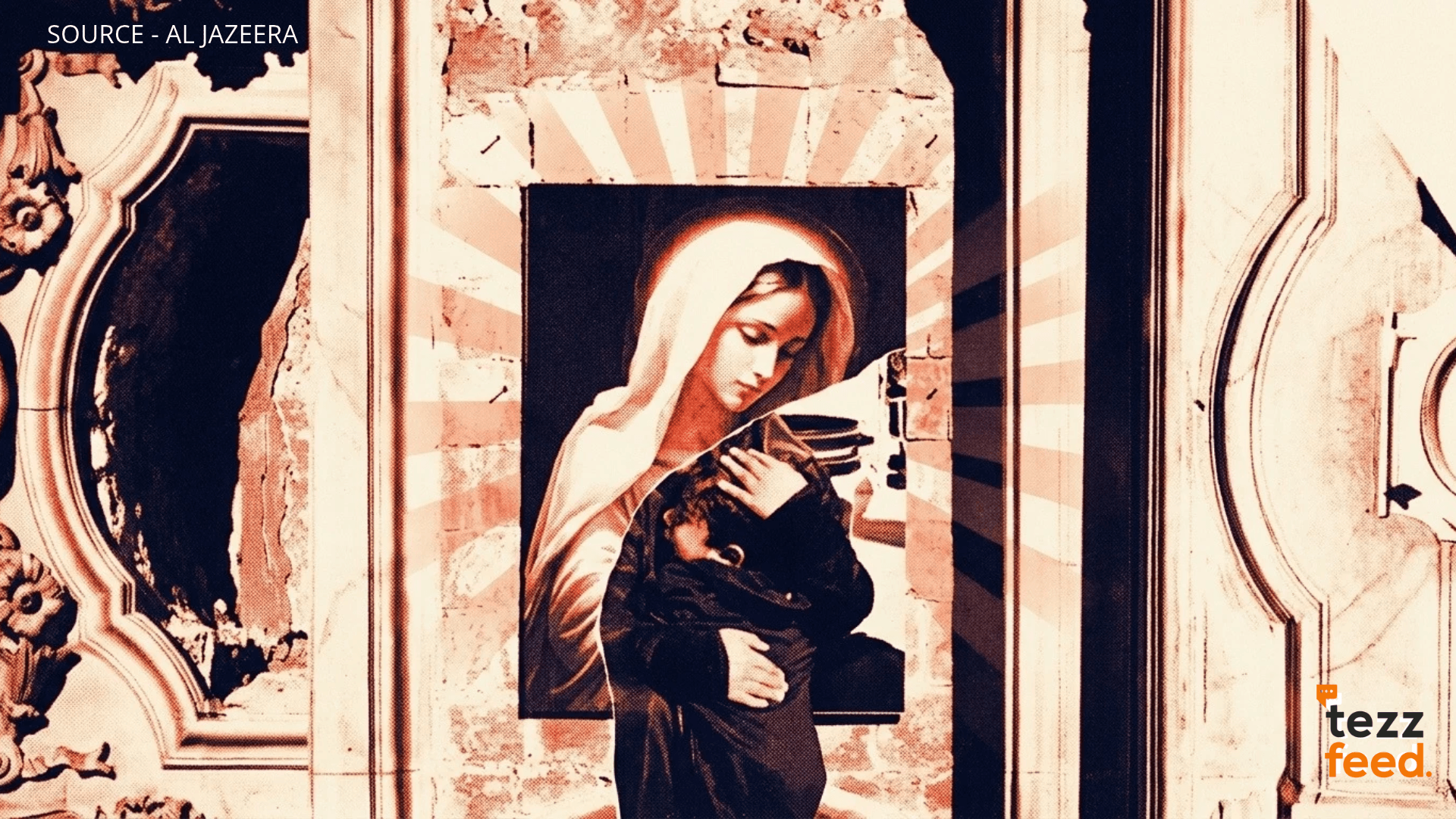
At first glance, the artwork appears to be a familiar depiction of the Virgin Mary holding the infant Jesus. However, the image carries a second, concealed layer. When Castaldo peels back part of the painted surface, a real photograph of a Palestinian mother embracing her child in Gaza emerges underneath. Captured by Palestinian photojournalist Omar El Qattaa, the photograph transforms the familiar religious composition into a contemporary portrayal of motherhood amid war. Rather than simply displaying two pictures side by side, Castaldo uses the physical act of tearing the outer image to connect two mothers, two children and two different historical realities. The resulting installation asks viewers to look beyond the familiar symbols of religious art and confront the experiences of Palestinian families living through conflict.
The central idea behind Holy Mothers of Gaza lies in the contrast between the traditional image of the Madonna and Child and the photograph concealed beneath it. For centuries, depictions of the Virgin Mary holding Jesus have represented maternal affection, protection, sacrifice, tenderness and spiritual devotion in Christian art. The Madonna and Child is among the most recognisable subjects in European religious painting, appearing in churches, chapels, homes and public devotional spaces. Castaldo takes this familiar visual language and places it in conversation with photographs documenting Palestinian motherhood during the war in Gaza. The connection is not based on religious identity but on a shared human experience of a mother holding her child and trying to protect them.
The decision to reveal the photograph by tearing the outer painting is particularly significant. The action does not simply replace one image with another. Instead, both remain visible, creating a relationship between the sacred representation and the contemporary documentary image. The tear becomes part of the artwork's meaning. It can be understood as a symbol of rupture, grief and the destruction experienced by families, while also suggesting that compassion begins when people are willing to look beneath familiar images and confront uncomfortable realities.
Castaldo has described the gesture, saying, “The tear of the icon becomes an act of necessary sorrow, it is the wound that heals, unites and moves us to compassion.”
The chapel installation is part of a larger project that extends beyond conventional galleries and exhibition spaces. Castaldo has brought Holy Mothers of Gaza into the streets of Naples, using the city's religious heritage and familiar neighbourhood landmarks to create a series of public artworks.
The project incorporates photographs by several Palestinian photojournalists, including:
Omar El Qattaa – whose photograph features in the Pappacoda Chapel installation.
Belal Khaled – whose documentary photographs have also been incorporated into the series.
Ali Jadallah – another Palestinian photographer whose work records events and human experiences in Gaza.
Ahmad Hasaballah – whose photographs contribute to the project's visual documentation of Palestinian suffering.
These photographs are combined with images of the Virgin Mary and baby Jesus, creating different visual compositions that bring Palestinian experiences into Naples' religious and cultural landscape. By introducing images of Palestinian mothers and children into these familiar spaces, Castaldo transforms ordinary street corners into places of public reflection. People do not necessarily have to visit a museum or an organised exhibition to encounter the artworks. They can discover them during their everyday journeys through the city.
The project has expanded over time. Earlier reporting in December 2025, documented 15 street installations. More recent reports describe 20 Madonna-themed works across Naples' historic centre, with the Pappacoda Chapel installation identified as Holy Mothers of Gaza No. 20. The changing figures reflect the project's development rather than a single fixed installation count.
The choice of Naples is an important part of the artwork's identity. Castaldo was born and raised in the southern Italian city in 1977. Its historic streets, religious traditions and neighbourhood culture are therefore not simply a backdrop for his work, they are part of the environment through which he communicates his ideas. Naples has a particularly visible tradition of popular devotion. Religious imagery is not confined to churches and museums but is woven into the architecture of everyday life. The city's small votive shrines serve as expressions of faith, memory and community identity.
The project has also received a response from local residents. In a report published on November 16, 2026, Italian newspaper la Repubblica described how women living in Naples' traditional neighbourhood buildings had embraced the artworks. According to Castaldo, local mothers had effectively adopted the Madonna installations in their neighbourhoods, identifying with the grief of Palestinian mothers. This community response gives the project a dimension beyond the artist's original intervention. The installations have become points of connection between local residents and the people represented in the photographs.
Castaldo's background helps explain why his work combines documentary photography, public art and political themes. He began his independent photojournalism career in 2006, initially covering organised crime, social problems and the activities of criminal organisations in southern Italy. His reporting on the Camorra, the organised crime network operating in the Naples region, brought his photographs to international publications.
In late 2008, he moved to Jerusalem, where he covered developments in Israel and Palestine, including Israel's 2008–2009 military operation in Gaza. He worked between Jerusalem and Cairo, documenting political unrest and social issues across the Middle East. In January 2011, Castaldo arrived in Cairo shortly before the Egyptian revolution began. He documented the demonstrations and confrontations in Tahrir Square during the uprising against President Hosni Mubarak. His photographic coverage of the Egyptian revolution earned him third prize in the Spot News category of the 2012 World Press Photo contest for his series Dawn of a Revolution. The award recognised his documentation of the demonstrations and violence surrounding the uprising.
However, after years of photographing conflict and political unrest, Castaldo began reconsidering his relationship with photojournalism. In 2014, he decided to leave his career as a conflict photojournalist. In an interview with the street-art publication UP Magazine, he explained his discomfort with the way photographs of vulnerable people from the Middle East were presented to Western audiences.
He questioned whether documenting people during their most painful experiences and selling those images to international media was ethically appropriate. He also expressed concern that photographers could unintentionally contribute to narratives that did not reflect the perspectives of the people being photographed. His decision was not an abandonment of the issues he had spent years documenting. Instead, it marked a change in how he wanted to communicate them.
Beginning in 2016, he started transforming photographs from his Middle Eastern documentary archive into street artworks, combining photography with other visual techniques. Rather than relying exclusively on newspapers and magazines, he began using public spaces to confront audiences with issues including political oppression, displacement, occupation, migration and human suffering.
His artworks reached international audiences through social media, with some attracting millions of views. He also continued developing a career in filmmaking, working as a still photographer on productions involving prominent Italian directors and international television companies.
One of Castaldo's earlier projects, Welcome to Bethlehem, focused on Palestinian workers waiting at Israeli military checkpoints to reach Jerusalem for employment. The project examined the restrictions and everyday difficulties experienced by Palestinians whose livelihoods depend on crossing these checkpoints. His broader artistic practice frequently combines documentary photographs with visual interventions in public spaces. He uses familiar images, historical references and unexpected juxtapositions to encourage audiences to reconsider subjects they might otherwise overlook.
Castaldo's project does not suggest that an artwork can end a war or reverse the suffering experienced by civilians. Instead, it uses visual storytelling to make the human consequences of conflict harder to ignore. By placing Palestinian mothers alongside one of Christianity's most enduring images of motherhood, he creates a connection between historical religious art and contemporary documentary photography.
In a historic Neapolitan chapel, an image traditionally associated with the birth of Jesus now opens a window onto the lives of Palestinian families. And beneath the familiar depiction of the Madonna and Child is a reminder that motherhood, love and the instinct to protect children do not belong to any single nation, religion or historical period but to all mothers.
Holy Mothers of Gaza ultimately asks viewers to recognise that the suffering of a mother in Gaza deserves the same human compassion traditionally associated with the most sacred images of motherhood.