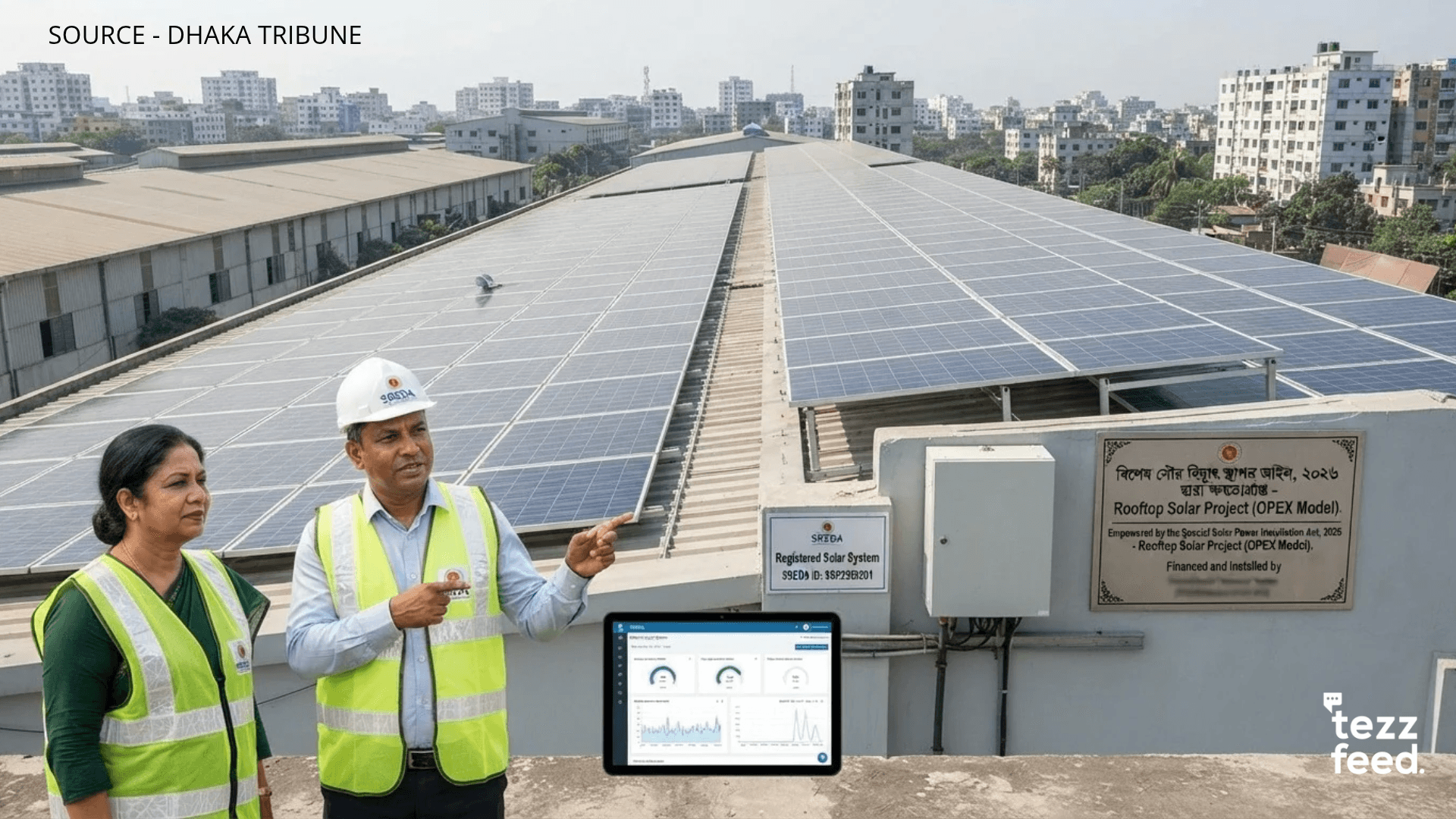
Bangladesh has introduced a dedicated legal framework to accelerate solar power generation, attract private investment and strengthen the country's energy security through renewable energy. The newly enacted Special Solar Power Installation Act, 2026, establishes regulations governing solar installations, investment models, procurement, electricity grid connections and environmental compliance.
The legislation is expected to make solar power projects easier to implement by simplifying administrative procedures and clarifying the responsibilities of government agencies, investors, service providers and consumers. The President assented to the law, which was published in an extraordinary Gazette on November 22, 2026, as Act No. 114 of 2026. It came into immediate effect.
Bangladesh remains heavily dependent on imported fossil fuels, including liquefied natural gas, coal and petroleum, for electricity generation. Rising international energy prices, foreign currency pressures and increasing electricity demand have made energy diversification an important national priority. Solar power offers an opportunity to reduce dependence on imported fuels, improve energy security and support the country's climate commitments. However, the expansion of rooftop solar installations and other renewable energy projects has faced challenges involving investment arrangements, electricity pricing, procurement procedures, grid connections and long-term maintenance.
The new legislation aims to address these challenges by establishing a clearer regulatory structure for solar power development. One of the major features of the law is the introduction of two investment models designed to make solar power accessible to both public and private institutions.
1. Operational Expenditure (OPEX) Model
Under this arrangement, a private solar service provider finances, installs, operates and maintains the solar power system. The customer provides a suitable rooftop or other approved space but does not need to make the initial investment. Payments to the service provider are made according to the electricity generated and the terms of the agreement.
This model could particularly benefit government institutions, schools, hospitals, factories and businesses that want to adopt solar energy without significant upfront expenditure.
2. Capital Expenditure (CAPEX) Model
Under this arrangement, the customer finances the solar installation and retains ownership of the system. Government institutions and organisations with sufficient financial resources can choose this model to develop their own renewable energy facilities.
The availability of both models is expected to encourage greater participation from private investors and reduce financial barriers to solar power adoption.
The legislation expands opportunities for solar installations beyond conventional rooftops.
Depending on applicable requirements, projects can include:
Rooftops of government and private buildings.
Residential and industrial premises.
Unused land and courtyards.
Water bodies through floating solar installations.
Tea gardens and agricultural locations.
Agrivoltaic systems, where solar panels and agricultural activities operate together.
The law covers designated solar installations of up to five megawatts, while large-scale ground-mounted solar projects remain outside its scope. This approach could help Bangladesh utilise available rooftops, unused spaces and water bodies without placing additional pressure on agricultural land.
The law requires an agreement involving the customer, solar service provider and relevant government authority. The agreement will establish responsibilities relating to equipment quality, installation, safety, maintenance, electricity distribution, pricing, warranties and payment arrangements.
Another important provision concerns net metering, which allows consumers to generate electricity through solar panels and supply surplus power to the national grid. Under this arrangement, electricity generated by a solar system can first be used to meet the consumer's own demand. Any additional electricity can be supplied to the grid through an approved connection. The surplus electricity will be adjusted against the consumer's electricity bill under applicable net-metering rules. Any remaining surplus may be compensated according to government-approved tariffs.
The legislation seeks to simplify coordination between solar power users and electricity distribution authorities, making grid connections more accessible. This provision could encourage households, factories and commercial establishments to invest in solar installations while contributing additional electricity to the national system.
Solar power is considered an important source of clean energy, but solar panels, batteries and associated electronic equipment create environmental challenges when they reach the end of their useful lives. The new law addresses this issue by requiring contracts to include provisions for the safe collection, return, recycling and disposal of damaged or expired solar equipment.
A take-back arrangement will require relevant service providers to retrieve unusable components and ensure their appropriate management. This is particularly important for Bangladesh, where electronic waste management remains a growing environmental concern.
Proper disposal and recycling can help prevent hazardous materials from contaminating soil and water while supporting a more sustainable renewable energy industry.
The law could also create opportunities for local solar equipment suppliers, installation companies, maintenance professionals and renewable energy entrepreneurs.
However, the success of the legislation will depend on effective implementation. Transparent procurement, reasonable electricity tariffs, affordable financing, reliable grid connections and strong environmental monitoring will be essential.
Bangladesh must also ensure that solar installations are properly maintained and that the promised environmental safeguards work in practice. The new law is more than an administrative measure. It represents an effort to make solar energy a larger part of Bangladesh's electricity supply, reduce dependence on imported fossil fuels and build a more sustainable and resilient energy sector.